
Choosing a Web Development Company in Pakistan: What Matters Beyond the Portfolio
A beautifully designed website can make a development agency look exceptionally capable. The presentation might feature refined typography, carefully considered animations and an impressive collection of completed projects. None of those qualities, on their own, tells you whether the underlying code is maintainable, the website is secure or the agency will deliver what it promises.
For a business investing in a new website, that distinction matters. The finished product may become responsible for customer enquiries, online transactions, bookings or essential business operations. Decisions made during development can affect the organisation long after the original project has ended.
Understanding how to choose a web development company in Pakistan therefore requires looking beyond visual presentation. You need to assess technical judgment, delivery practices, contractual responsibilities and the practical consequences of working with a particular team.
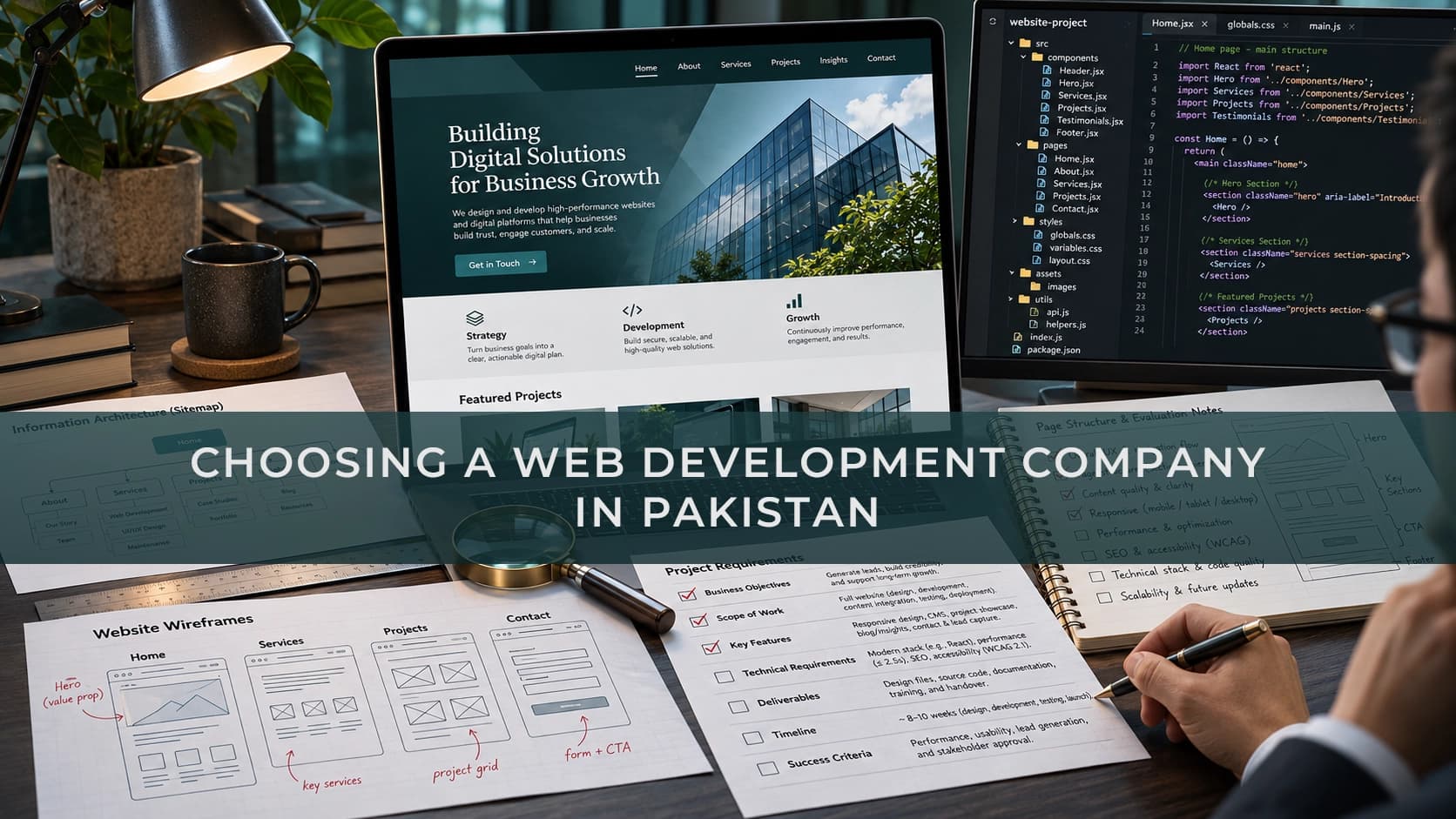
What a portfolio can tell you, and what it cannot
A portfolio remains a useful starting point. It demonstrates how an agency approaches visual identity, page composition, navigation and the presentation of information.
Well-executed projects may also suggest experience with particular industries or types of websites. A company that has delivered complex booking systems, for example, has potentially relevant experience for a business requiring appointment management.
The difficulty is determining what the agency actually contributed.
A portfolio entry might represent a complete development project, a visual redesign, a template customisation or a concept that was never deployed. These are different kinds of work, and they shouldn't be treated as equivalent evidence.
Ask shortlisted agencies to identify their role in each relevant project. Where possible, request a live website rather than relying exclusively on screenshots or promotional videos.
Visit the site on a mobile phone. Try its navigation, forms and other interactive features. Consider whether its content is readable, whether the interface behaves predictably and whether important actions are easy to complete.
Key Responsibilities You Cannot Inspect Directly:
- •Did the agency develop the underlying functionality or only the interface?
- •Which technical decisions made the project suitable for its intended users?
- •How was the website tested before launch?
- •Who maintains the application now?
- •Can the agency explain a significant problem encountered during development and how it was resolved?
These questions help distinguish presentation skills from demonstrated delivery capability.
An agency's portfolio of completed work should provide material for a meaningful discussion, not serve as the final justification for hiring it.
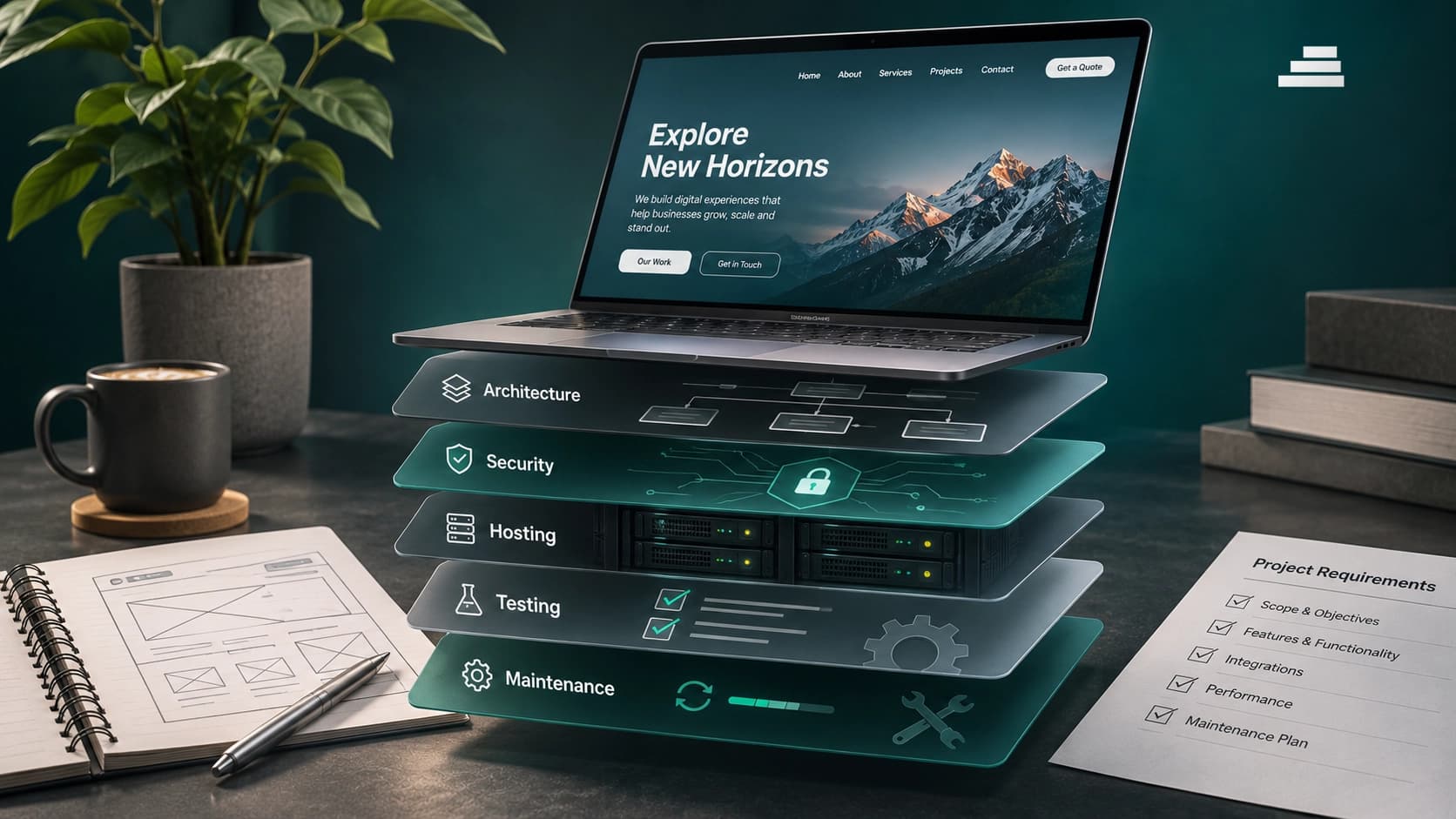
Begin with your requirements, not the agency's technology
Before requesting quotations, prepare a short project brief explaining what the website needs to accomplish.
For a professional services firm, the principal requirement might be generating qualified enquiries. An online retailer may need product management, order processing and inventory integrations. A growing company might require a multilingual corporate website that its marketing team can update independently.
These different requirements influence the technical approach, budget and type of development partner you need.
Your initial brief should identify the intended audience, essential features, content responsibilities, integrations, approximate budget and target launch period.
Distinguish between requirements that are essential at launch and functionality that can be introduced later. This gives agencies an opportunity to recommend sensible phases rather than pricing every possible feature into the initial build.
A capable development team should challenge unclear assumptions. If you request a custom customer portal, for example, it should establish whether an existing system could meet the same requirement before proposing bespoke development.
How to evaluate technical expertise without being a developer
You don't need to understand programming languages to assess the quality of an agency's technical thinking. You need to understand how it explains decisions, manages dependencies and demonstrates that its work can be maintained.
Start by asking the agency to describe its proposed architecture in plain English.
For a typical business website, the explanation might cover how pages are delivered, where content is stored, how enquiries are processed and which services are responsible for hosting and security.
For a more complex application, it should also address databases, user permissions, integrations and deployment.
The most revealing question is often why the agency recommends a particular solution over reasonable alternatives.
A team with sound technical judgment can explain both the strengths and limitations of its preferred approach. If every business problem leads to exactly the same technology, regardless of requirements, the recommendation deserves closer examination.
Ask how developers collaborate and review work. Version control, usually managed through Git, records changes to the code. A staging environment provides a place to review changes before they reach customers. Code reviews and automated checks can help identify defects earlier.
You don't need access to confidential client repositories. A sample delivery plan, anonymised review process or demonstration of the development workflow may provide useful evidence.
Also establish who will perform the work. The agency selling the project isn't necessarily the team developing it. Subcontracting isn't inherently problematic, but accountability, quality control and communication should remain clear.
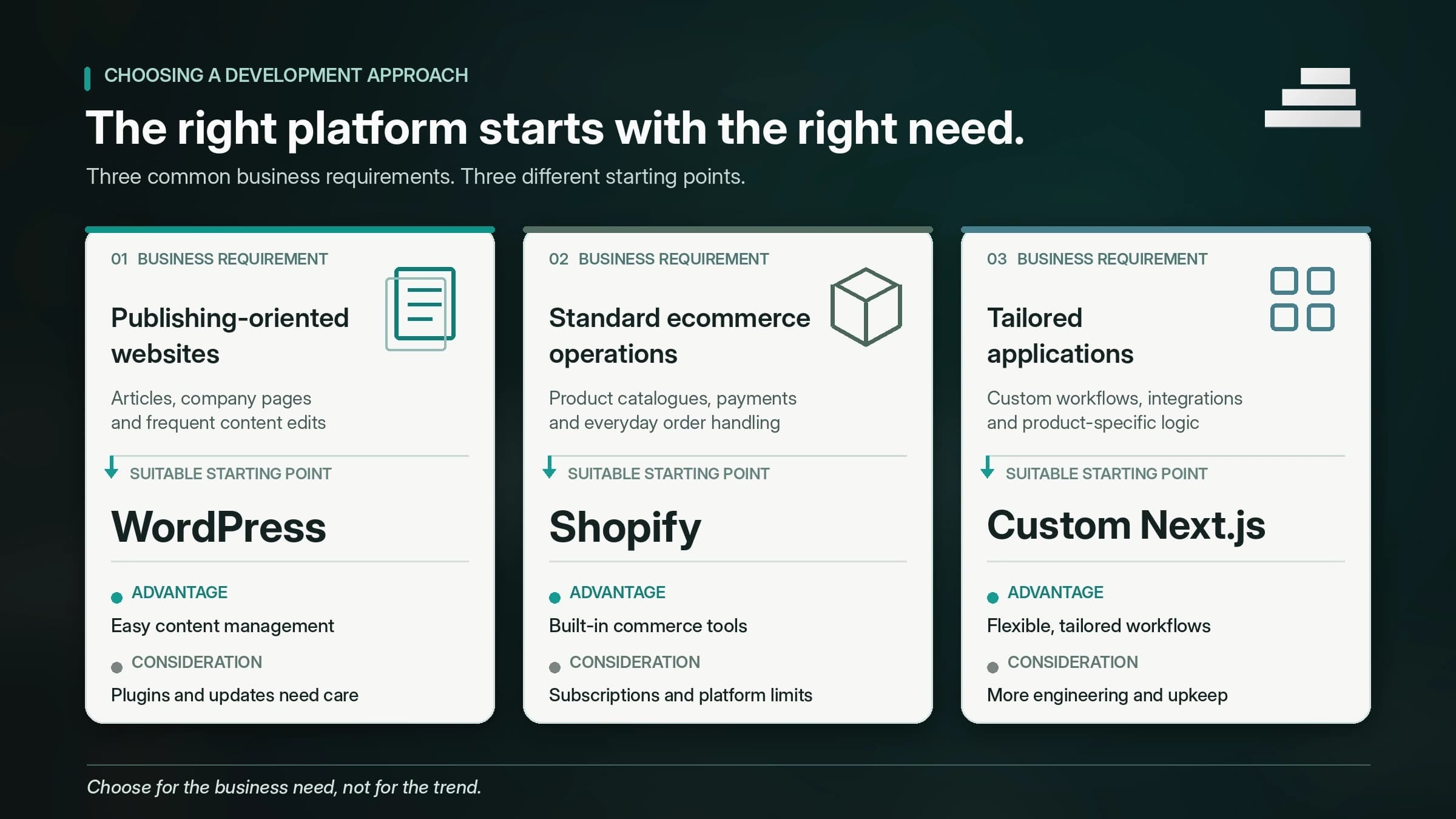
Choosing between custom development, WordPress and Shopify
Technology selection deserves particular attention when comparing website development companies in Pakistan.
A custom-built website may offer greater control over its architecture and interactions. A content management system can simplify publishing. An established ecommerce platform may provide substantial functionality that would otherwise need to be developed and maintained. None is automatically the correct choice.
WordPress: suitable when content management matters
WordPress can be an appropriate option for corporate websites, publications and businesses that need established editorial workflows.
Its themes and plugins can reduce development time, although extensive customisation and multiple third-party dependencies may increase maintenance responsibilities.
The agency should explain its plugin selection, update process and backup strategy. WordPress's official maintenance guidance specifically addresses backups and compatibility checks before updates.
Shopify: suitable for established ecommerce workflows
Shopify provides an integrated commerce environment with product management, storefront functionality and platform-supported checkout capabilities.
It can be attractive when a business wants to prioritise merchandising and operations rather than maintain its own commerce infrastructure.
The trade-offs include subscription costs, platform-specific constraints and potential dependence on applications or custom integrations.
For businesses operating in Pakistan or selling internationally, verify payment-provider eligibility, settlement currencies and regional requirements before committing to an implementation. Shopify's official online store documentation provides a useful starting point for understanding the platform's standard capabilities.
Custom Next.js development: suitable when requirements justify it
Next.js can support tailored interfaces, server-rendered content, dynamic functionality and more sophisticated application architectures.
Its official documentation explains how server and client components support different rendering and interaction requirements.
That flexibility can be valuable when a project requires distinctive user experiences, complex integrations or custom business processes. It also introduces engineering responsibilities. Content management, authentication, deployments, monitoring and ongoing upgrades must be appropriately designed and maintained.
A five-page company website doesn't automatically require a custom application simply because the technology is modern. For businesses comparing a custom website with a template-based solution, the relevant question is whether the additional flexibility solves a meaningful business requirement.
Performance, accessibility, security and SEO should be part of the specification
A website can look excellent in a design presentation while creating frustrating experiences for actual visitors. Performance should therefore be discussed before development starts, rather than treated as an optional optimisation after launch.
Google's Core Web Vitals measure three important aspects of the user experience:
How quickly the main visible content loads.
How promptly the page responds to user interactions.
How much visible content unexpectedly moves during use.
Google's recommended good-experience thresholds are LCP within 2.5 seconds, INP at or below 200 milliseconds and CLS at or below 0.1, assessed using the appropriate real-user measurement methodology.
These are useful benchmarks, not promises that every page will always achieve a particular result. Network conditions, devices, content and third-party services all affect performance. Ask which pages will be tested, what tools will be used and how the agency will handle problems discovered before launch.
Accessibility deserves equal consideration. The Web Content Accessibility Guidelines (WCAG) 2.2 provide established criteria for making digital interfaces more accessible. Practical expectations include meaningful form labels, keyboard navigation, sufficient text contrast and interfaces that work with assistive technologies. Agree on the accessibility target and testing scope instead of accepting a general promise of compliance.
Security requires similarly specific answers. HTTPS is essential, but encryption in transit alone doesn't make an application secure. For websites with customer accounts, administrative panels or sensitive data, ask about access permissions, authentication, dependency updates, backups and vulnerability testing. The OWASP Application Security Verification Standard provides a recognised framework for defining and evaluating web application security requirements.
Search visibility also begins with technical decisions. Pages need meaningful content structure, accessible internal links and appropriate indexing controls. Google's SEO Starter Guide explains the foundations.
A responsible agency can explain how these requirements will be implemented and verified. It shouldn't guarantee search rankings or promise flawless security.
A professional proposal should explain how delivery will be verified
A quotation containing a price, page count and estimated completion date isn't sufficient for a substantial website project.
A useful proposal establishes what will be delivered, how the work will progress and how both parties will decide whether a milestone has been completed.
Expect the document to define the website's page types and functionality, proposed technology, design deliverables, content responsibilities, integrations, hosting arrangements and exclusions.
It should also explain the project schedule. Discovery and planning may lead to wireframes or technical specifications. Design approval should precede substantial implementation work where appropriate. Development should lead to testing, client review, corrections and an agreed launch process. The exact sequence can differ, but responsibilities shouldn't remain ambiguous.
Make acceptance criteria observable
Consider a proposal that promises a "fully functional enquiry form".
That statement leaves important questions unanswered. Where are submissions delivered? What happens when a field is invalid? Will the form connect to a CRM? Who tests the integration?
A stronger acceptance criterion might require successful delivery to a specified email or CRM, appropriate validation messages, documented error handling and testing across agreed browsers and devices. The same principle applies to ecommerce checkout, administrative permissions, search functions and other essential features.
Revision allowances also need definition. A change to spacing or typography isn't equivalent to adding a new customer registration system. Agree on the number or scope of design revisions, the process for requesting changes and how additional work will be priced.
Milestone payments can be sensible when tied to clearly identified deliverables. A published development process can indicate how an agency approaches discovery, design, implementation and launch, but the actual project agreement should contain the commitments that govern your work.
Establish ownership before signing the agreement
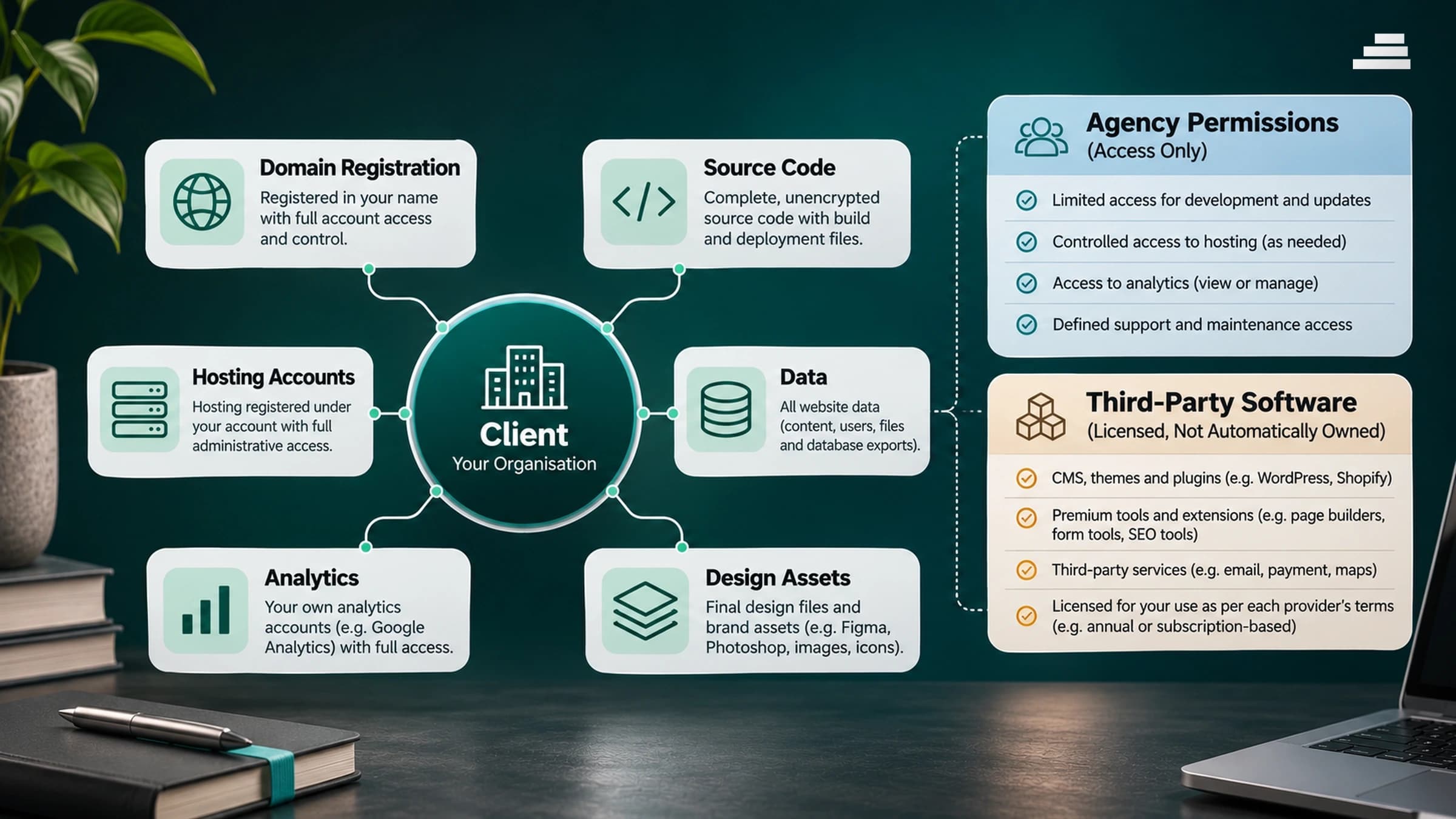
Ownership is among the most consequential questions in website procurement, particularly when a business expects to use its website for years. A website involves several different assets, and access to one doesn't necessarily establish control over the others.
Identify the legal registrant and make sure the business has appropriate control over renewal, account recovery and DNS settings. ICANN's registrant guidance explains the relationship between registrants and registrars.
Specify which custom code will be assigned or licensed to the client, when those rights take effect and what files or repository access will be delivered.
Clarify who controls billing, infrastructure configuration, credentials and the ability to move the application elsewhere.
Address ownership of original designs, copy and media separately from third-party fonts, images, themes or other licensed materials.
Define access to databases, customer records, backups, analytics properties and connected business systems.
Not every component can be transferred as unrestricted intellectual property. Open-source dependencies, commercial software and hosted platforms have their own licence terms. The agreement should distinguish client-owned deliverables from software the business is licensed to use.
An agency may reasonably transfer ownership of commissioned work after final payment, provided the arrangement is clear from the outset. The essential protection is a documented handover and an agreed path for changing providers.
Communication and post-launch support reveal operational maturity
Development projects involve decisions that can't all be predicted at the quotation stage. An integration may behave differently than expected. Content delivery might be delayed. Testing may uncover a requirement that wasn't properly defined.
The agency's ability to document and resolve these situations matters as much as its original development plan.
Before signing, establish who will manage the project, which communication channel will be used and how frequently progress will be reviewed. Ask to see the expected format of milestone updates. Useful updates explain what's complete, what's awaiting approval, which risks have emerged and what happens next.
For overseas clients working with a Pakistan-based team, establish overlapping meeting hours, written approval procedures and a clear escalation contact. Time-zone differences are manageable when expectations are explicit.
Support arrangements need similar precision. A post-launch agreement should identify who handles security updates, failed forms, hosting incidents, software dependencies, backup restoration and requests for new functionality.
Distinguish defect correction from new development. Define response arrangements for critical incidents and explain whether support is included, billed as needed or provided through a recurring maintenance agreement. Businesses should also receive the documentation and training necessary to operate the website without unnecessary dependence on its original developers.
Compare the full cost of ownership, not only the initial quotation
Web development cost in Pakistan varies according to scope, complexity, integrations, content requirements and the delivery team.
A lower quotation can represent good value if it meets the same requirements with less unnecessary complexity. It can also omit work another agency has included.
Ask every shortlisted company to separate initial development costs from recurring expenditure. Potential ongoing costs include hosting, domain renewals, licensed software, ecommerce subscriptions, third-party API usage, maintenance, monitoring and future feature development.
Our website development cost guide examines these factors in more detail, while the hosting guide provides further context on infrastructure choices.
For Pakistani and overseas buyers, quotations should clearly establish the payment currency, applicable taxes, bank or transfer charges and responsibility for exchange-rate differences.
A fair comparison considers the first-year commitment and the likely operational costs over the following two years. These forecasts should be based on each proposal, not assumed market averages.
An agency evaluation scorecard for comparing proposals
Once you've shortlisted two or three agencies, compare them using the same criteria. The following scorecard is an illustrative procurement framework. Its weights reflect a reasonable emphasis on delivery risk and long-term control, not published industry research.
Rate each agency from 0 to 5 against every criterion, using the supporting evidence you have received.
| Evaluation criterion | Weight | Evidence to request | A | B | C |
|---|---|---|---|---|---|
| Business understanding and scope | 15% | Requirements, assumptions, priorities | — | — | — |
| Architecture and technical suitability | 15% | Platform rationale, relevant work | — | — | — |
| Performance, accessibility and security | 15% | Test plan, quality targets, controls | — | — | — |
| Delivery planning and quality assurance | 15% | Milestones, reviews, acceptance criteria | — | — | — |
| Ownership and exit arrangements | 15% | Contract terms, handover schedule | — | — | — |
| Maintenance and operational continuity | 10% | Support scope, backups, incident response | — | — | — |
| Communication and accountability | 10% | Named contacts, reporting, escalation | — | — | — |
| Commercial clarity and running costs | 5% | Itemised costs, exclusions, renewals | — | — | — |
| Total | 100% | Composite Procurement Score | /100 | /100 | /100 |
Scoring Guidelines & Calculation:
Use 0 when there is no meaningful answer or evidence, 1 for a weak response, 3 for an adequate documented approach and 5 for convincing, relevant evidence. Scores of 2 and 4 represent intermediate assessments.
Criterion points = (Agency score ÷ 5) × Criterion weight
For example, an agency scoring 4 out of 5 on a criterion weighted at 15 points receives 12 points. Add the weighted contributions to obtain a total out of 100.
Don't treat the highest score as an automatic hiring decision. Unresolved ownership rights, unacceptable security arrangements or unclear legal commitments may justify rejecting a proposal regardless of its overall rating. The scorecard works best when supported by written evidence and reviewed by the people responsible for approving the investment.
Warning signs that deserve closer examination
Certain patterns should prompt additional questions before a contract is signed.
⚠Be cautious when an agency won't identify who will perform the work, refuses to specify deliverables or avoids explaining how the website will be handed over.
⚠Promises of guaranteed Google rankings, universally perfect performance scores or complete immunity from security problems should also be treated sceptically.
⚠Commercial terms deserve careful review when significant payments aren't connected to verifiable work, changes can be charged without prior approval or the agreement provides no reasonable process for dealing with disputes or early termination.
⚠An agency's reluctance to discuss limitations can be as revealing as its technical answers.
These warning signs don't always mean a company is unsuitable. They indicate that the buyer needs clearer evidence or stronger contractual protection.
Final website procurement checklist
Before committing to a development partner, confirm that you have:
A business owner doesn't need to become a technical specialist to make a sound purchasing decision. The objective is to create enough clarity that the agency's promises can be evaluated and, where necessary, enforced.
Choose a partner whose work you can understand and verify
A strong web development partner combines design judgment with sound engineering, realistic planning and responsibility for what happens after launch.
The right company for a small corporate website may not be the right team for a complex customer platform. Likewise, the most visually impressive proposal may not provide the strongest delivery plan.
Compare agencies on the evidence they provide, the decisions they can explain and the responsibilities they're prepared to document.
If you're preparing a website project and want to discuss its technical requirements, ownership arrangements or delivery scope, you can arrange a project consultation with Stratify Studio.
The goal is to understand what you're commissioning before committing to the build.
Plan Your Next Digital Build With Verified Milestones
No vague promises or hidden retainer lock-ins. We map out full source-code ownership, transparent running costs, and enterprise-grade Next.js architecture before you spend a single rupee.