
Website Development in Pakistan: What a Professional Build Actually Includes
Two business websites can look almost identical on a laptop screen and represent very different levels of engineering. Both might have attractive layouts, responsive navigation and working contact forms. One may be a well-configured template. The other may involve custom application logic, integrations, automated testing and a carefully planned deployment.
Neither approach is inherently better. The difference lies in what the business needs, how the website is developed and what happens when something needs to change.
For businesses evaluating website development in Pakistan, understanding that distinction is essential. A development quotation can cover anything from assembling a handful of pages to engineering a platform that manages customers, transactions or internal processes.
The important question is what a professional build should include, which responsibilities depend on the project and how you can verify that the work has been delivered properly.

A Professional Website Is Defined by Its Requirements, Not Its Price or Technology
A small business website might need only a few carefully designed pages, an enquiry form and a straightforward way to update content. A retailer may require product management, checkout, inventory controls and order notifications. A customer portal could need authenticated accounts, permissions, databases and connections to existing business software.
These are different engineering problems.
The professional standard isn't determined by how much custom code an agency writes. It comes from selecting an appropriate solution, implementing it competently and establishing what the business will need to operate it.
A template-based website can be professionally delivered when its structure, accessibility, functionality and maintenance have received proper attention. Equally, an expensive custom application can be poorly engineered.
It helps to distinguish three broad levels of development:
| Project type | Typical requirements | Main consideration |
|---|---|---|
| Business or informational website | Service pages, navigation, content, contact forms | Clear communication and straightforward maintenance |
| Content-managed or ecommerce platform | Editorial tools, products, orders, subscriptions or integrations | Reliable operations and manageable workflows |
| Custom web application | User accounts, dashboards, business logic, databases and APIs | Application architecture, security, testing and ongoing development |
The boundaries aren't fixed. A corporate website can contain sophisticated application features, and an ecommerce business may operate effectively without any bespoke backend development.
The purpose of classification is to understand the work, not attach a quality ranking to different kinds of websites.
The Five Layers of a Professional Website Build
A useful way to understand website development is to separate the work into five connected layers. Each has a different purpose, and each should leave behind something the client can review.
Business requirements and planning
Development should begin by establishing what the website needs to accomplish. For a consultancy, that might mean helping prospective customers understand its services and submit qualified enquiries. For a distributor, the priority could be presenting a large product catalogue with accurate specifications and stock information.
The discovery process should identify target users, business goals, page requirements, essential features, content responsibilities, integrations and budget constraints. These decisions become the foundation of a written project scope.
Without an agreed scope, seemingly minor assumptions can create expensive disagreements. A request for a "customer dashboard", for instance, might mean a simple account page to one party and an entire reporting system to another.
What to verify: An approved requirements document or project specification that distinguishes essential functionality from optional features.
User experience and visual design
User experience, commonly called UX, concerns how people understand and move through a website. Interface design, or UI, deals with the visual and interactive elements through which they do so.
The work may include an information architecture that organises pages, navigation structures, wireframes and high-fidelity screen designs.
Responsive design ensures that layouts adapt to different screen sizes. It also requires judgment about spacing, typography, navigation and interaction, rather than simply shrinking a desktop layout to fit a phone. A business website with elegant visuals but confusing navigation can still fail to serve its intended users.
What to verify: Approved page structures, representative desktop and mobile designs, interaction requirements and an agreed revision process.
Application engineering and integrations
Engineering turns the approved experience into working software. Frontend development creates what visitors interact with in their browsers. Backend development, where required, handles server-side operations such as data processing, authentication, application rules and integrations.
Some websites can operate with static content and third-party forms. Others need dedicated databases, application programming interfaces (APIs) and administrative systems. The architecture should reflect these requirements, not introduce complexity merely to demonstrate technical sophistication.
What to verify: Working features in a review environment, a documented technology approach and confirmation that the agreed integrations operate correctly.
Quality assurance, performance and security
A website isn't ready simply because its pages appear correctly in a developer's browser. Quality assurance examines whether features work under expected and unexpected conditions. Performance testing checks how the website behaves on different devices and connections. Security practices protect systems and data against relevant risks.
Accessibility and technical search readiness also need attention before release. Without defined quality checks, problems may only become visible when customers encounter them.
What to verify: A test plan, documented defects and resolutions, agreed quality criteria and approval of the final website before launch.
Deployment, ownership and ongoing operations
The final layer concerns making the website available to the public and establishing how it will be managed. This can involve hosting configuration, domain settings, deployment procedures, access credentials, backups, documentation and training.
A business should understand who controls its website, who can modify it and what happens when the original development arrangement ends.
What to verify: A completed handover covering the applicable accounts, files, operational instructions and post-launch responsibilities.
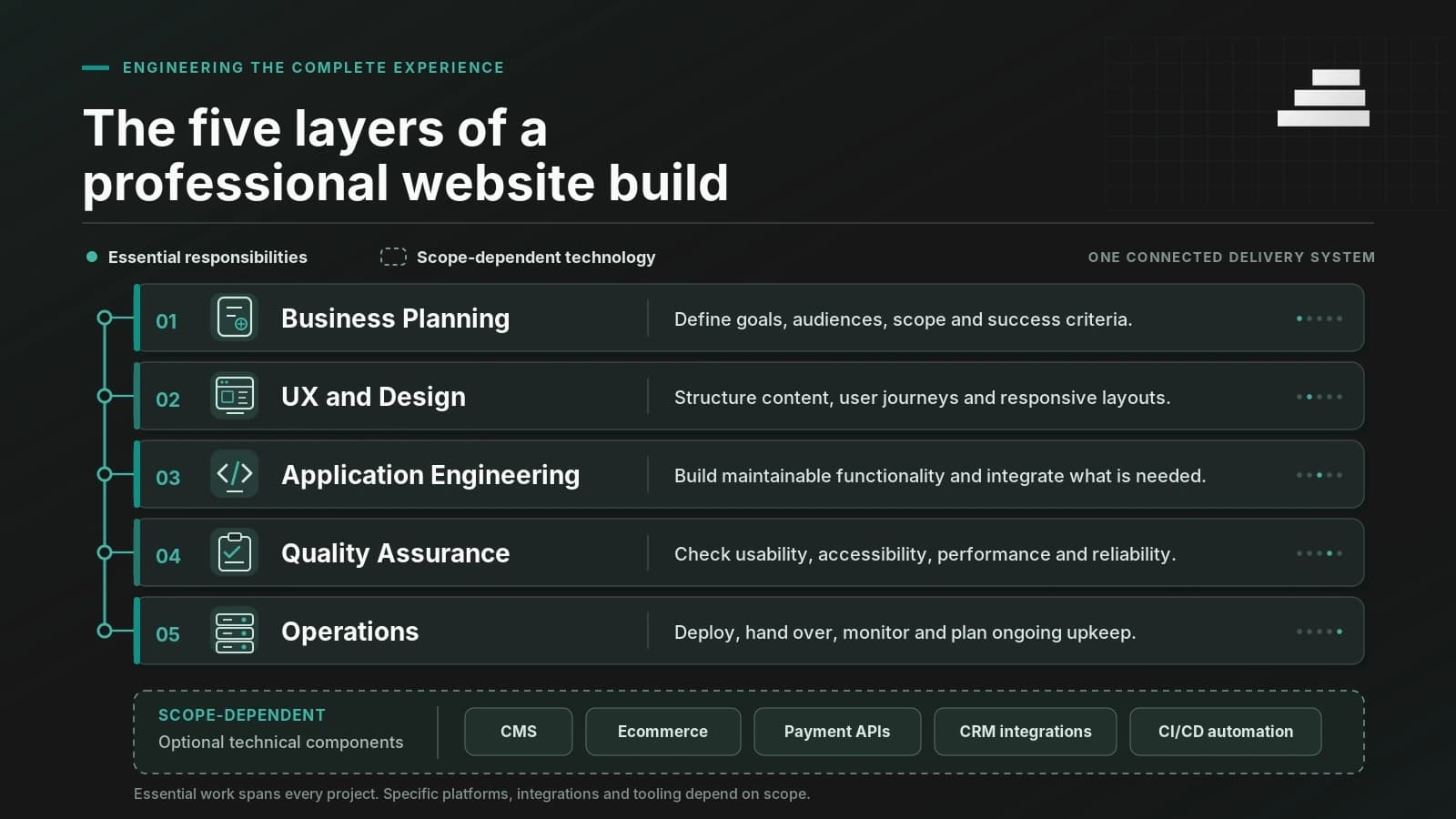
Caption: Professional website delivery combines technical work with planning, testing and long-term responsibilities.
These layers don't always happen in a perfectly linear sequence. Design and development may overlap, and testing should occur throughout implementation. Their value lies in making the responsibilities visible and accountable.
Choosing the Right Development Approach
Technology discussions often begin with names such as WordPress, Shopify, React, Next.js, PHP or Laravel. These aren't equivalent products. Some are content management systems, some are ecommerce platforms, and others are programming tools or frameworks used to construct applications.
Selecting one should follow the business requirements.
When templates and WordPress make sense
A template can provide an efficient starting point for a relatively straightforward website. It may reduce the amount of design and engineering work required while providing familiar layouts and established functionality.
WordPress adds content-management capabilities that can be particularly useful for businesses publishing articles, case studies, services or frequently updated information.
Its themes and plugins can extend functionality, but they also introduce maintenance responsibilities. Updates need compatibility checks, backups and appropriate testing. The official WordPress documentation explains these considerations.
The weakness isn't using WordPress or a template. It is relying on poorly selected extensions, unclear responsibilities or customisations that become difficult to maintain.
When Shopify is a practical ecommerce choice
Shopify offers an established environment for product catalogues, storefronts and online sales. For a business selling clothing, cosmetics, equipment or other physical products, using an existing commerce platform may be more sensible than building every store function independently. Custom themes and integrations can still require substantial development.
Pakistani businesses must pay particular attention to payment processing. Shopify Payments doesn't currently list Pakistan among its supported business locations, so merchants need to assess eligible third-party providers and available payment methods. This should be verified against the official eligibility list before implementation. Domestic and international selling may also require different arrangements for currencies, shipping, taxation and settlement.
When custom Next.js or backend development is justified
React is a JavaScript library for building user interfaces. Next.js is a framework built around React that provides additional capabilities for routing, rendering and application development.
For websites with distinctive interfaces, sophisticated content presentation or integration requirements, Next.js may be a suitable choice. Its official documentation explains how applications can combine server-rendered content with client-side interaction.
PHP and Laravel are also valid choices for systems involving business rules, administrative tools and database operations. A project can use different frontend and backend technologies together when the architecture justifies that separation.
Custom development becomes more useful when off-the-shelf software imposes meaningful constraints on the business. It also requires ongoing responsibility for the parts the team builds.
A custom system shouldn't be recommended simply because an agency prefers a particular framework. Businesses considering custom website engineering should expect a clear explanation of why the chosen architecture suits their requirements.
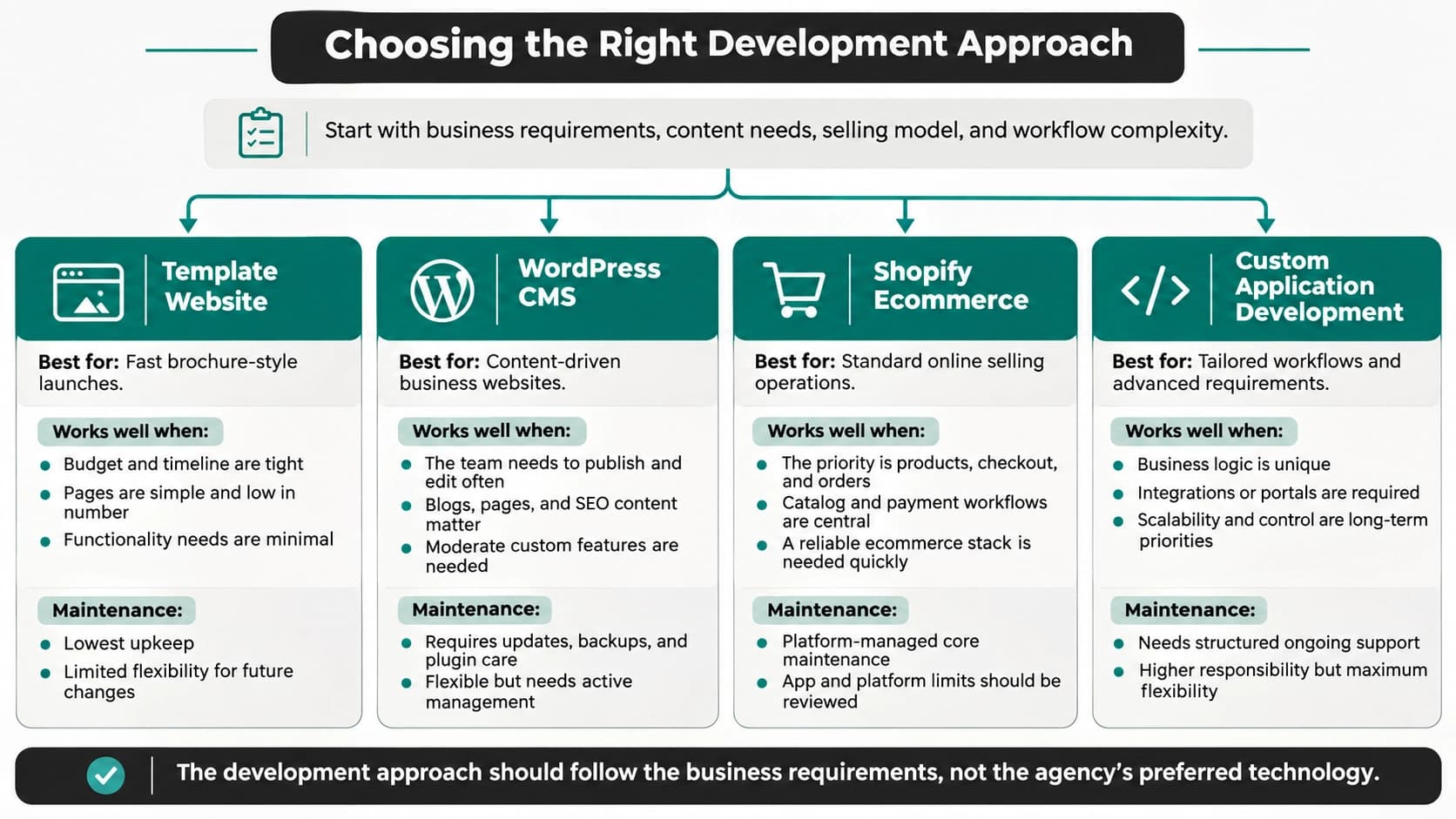
Caption: The development approach should follow the business requirements, not the agency's preferred technology.
What Frontend and Backend Engineering Actually Involve
A visitor sees a website through its frontend: the layout, navigation, text, images, buttons and interactive features. Behind some of those interactions may be services the visitor never sees.
Consider a business enquiry form. The visible interface might collect a name, email address and project details. The system receiving that information may need to validate submissions, reduce spam, forward enquiries to an authorised destination and handle failures.
If the form connects to a customer relationship management system, the developer must also account for authentication, API permissions and unsuccessful requests. The implementation could use a managed form service, a serverless function or a custom backend. A dedicated database may not be needed.
Now consider a customer portal that stores confidential documents. It may require authentication, separate user permissions, secure storage, account recovery and a database structure that prevents users from accessing one another's records.
These requirements are substantially different from those of a public enquiry form. Professional engineering involves choosing the necessary components, defining how they interact and planning for failure as well as success.
Maintainability matters here. Reusable components, clear configuration, version control and documentation make it easier to investigate problems and introduce changes without unnecessarily disturbing unrelated features.
Clients don't need to inspect every line of code. They should be able to ask what has been built, which external services it relies on and how another qualified developer could maintain it.
Performance, Accessibility, Security and SEO Belong in the Development Scope
Technical quality shouldn't be reserved for an optional improvement phase. The required depth varies by project, but fundamental expectations should be agreed before development begins.
Performance should be measured, not assumed
Large images, unnecessary JavaScript, excessive third-party scripts and inefficient server responses can affect how quickly a website becomes useful. Google's Core Web Vitals measure loading experience, interaction responsiveness and visual stability.
Within 2.5 seconds
Largest Contentful Paint
200 ms or less
Interaction to Next Paint
0.1 or less
Cumulative Layout Shift
These values are assessed using real-user data at the 75th percentile where sufficient measurements exist. They are benchmarks, not guaranteed results for every visit. An agency should explain which representative pages it will assess and how it will handle performance problems within the agreed scope.
Accessibility is a design and engineering responsibility
Accessible websites consider people who navigate with keyboards, use assistive technology or have visual and other impairments. Relevant practices include clear headings, meaningful form labels, appropriate colour contrast, visible keyboard focus and understandable error messages. The Web Content Accessibility Guidelines 2.2 provide testable requirements.
The project should identify its intended accessibility standard and testing responsibilities. A website can't reasonably claim complete accessibility simply because an automated checker reports no detected errors.
Security depends on the actual risks
HTTPS protects information in transit, but doesn't independently establish the security of a website. Applications with user accounts or sensitive data require additional controls, including appropriate authentication, access restrictions, server-side validation and secure handling of credentials. The OWASP Application Security Verification Standard provides a structured reference for application security requirements.
A small public website and a financial platform won't need identical security assessments. Their controls should correspond to the data and functionality involved.
Technical SEO creates the conditions for search visibility
A professionally developed website should provide search engines with an understandable structure. Depending on the project, this includes meaningful HTML headings, descriptive page titles, logical internal links, canonical URLs, appropriate indexing directives and XML sitemaps.
Search engines must also be able to access the content intended for indexing. JavaScript-heavy websites deserve particular care with rendering and discoverability, as explained in Google's JavaScript SEO guidance .
Technical SEO is different from ongoing keyword research, content publishing and link acquisition. A development company can prepare a sound technical foundation without guaranteeing search rankings.
Testing Is Where a Finished Design Becomes a Dependable Website
A professional testing process should cover more than opening the homepage on a laptop. The team should review representative pages across agreed browsers and devices, verify navigation and forms, and confirm that essential features behave correctly.
For ecommerce, testing might include adding products to a basket, applying discounts, completing payments through an appropriate test environment and handling unsuccessful transactions. For an appointment platform, it could involve unavailable time slots, double-booking prevention and notification failures.
Errors matter as much as successful interactions. Users need understandable feedback when a form submission fails, and the business needs a way to identify operational problems.
A staging environment allows stakeholders to review the website before it becomes publicly available. Reported defects should be tracked and classified so that essential fixes aren't confused with new feature requests.
Final acceptance should be based on agreed requirements, not a general impression that the website looks complete.
Launching a Website Also Means Transferring Operational Responsibility
Deployment makes the completed website available through its intended domain. The process may include configuring the production environment, connecting DNS records, enabling HTTPS, applying environment-specific settings and checking important functions after release.
Hosting decisions depend on the application. Static websites can often use comparatively simple infrastructure. Applications requiring server-side execution, databases or background jobs need suitable runtime services. Next.js, for example, supports different deployment approaches , including Node.js servers, containers and static exports, with different capabilities and limitations.
No particular hosting model is universally required. The more important commercial question is who will operate the chosen infrastructure and who will retain control of it.
A proper handover should address domain registration, hosting or platform accounts, source-code deliverables, design files, relevant data and administrative permissions.
Ownership and access aren't identical. A development agency may have administrator access to a service without being its legal owner. A business may own commissioned code while continuing to use licensed themes, libraries or third-party software. These distinctions belong in the project agreement.
The developer should also explain how backups are created, whether restoration has been tested and how the website can be moved or maintained if the relationship changes.
Post-launch support needs a defined scope. Fixing a defect, updating a dependency, restoring a backup and building a new feature are different responsibilities. The business should know who handles each one.
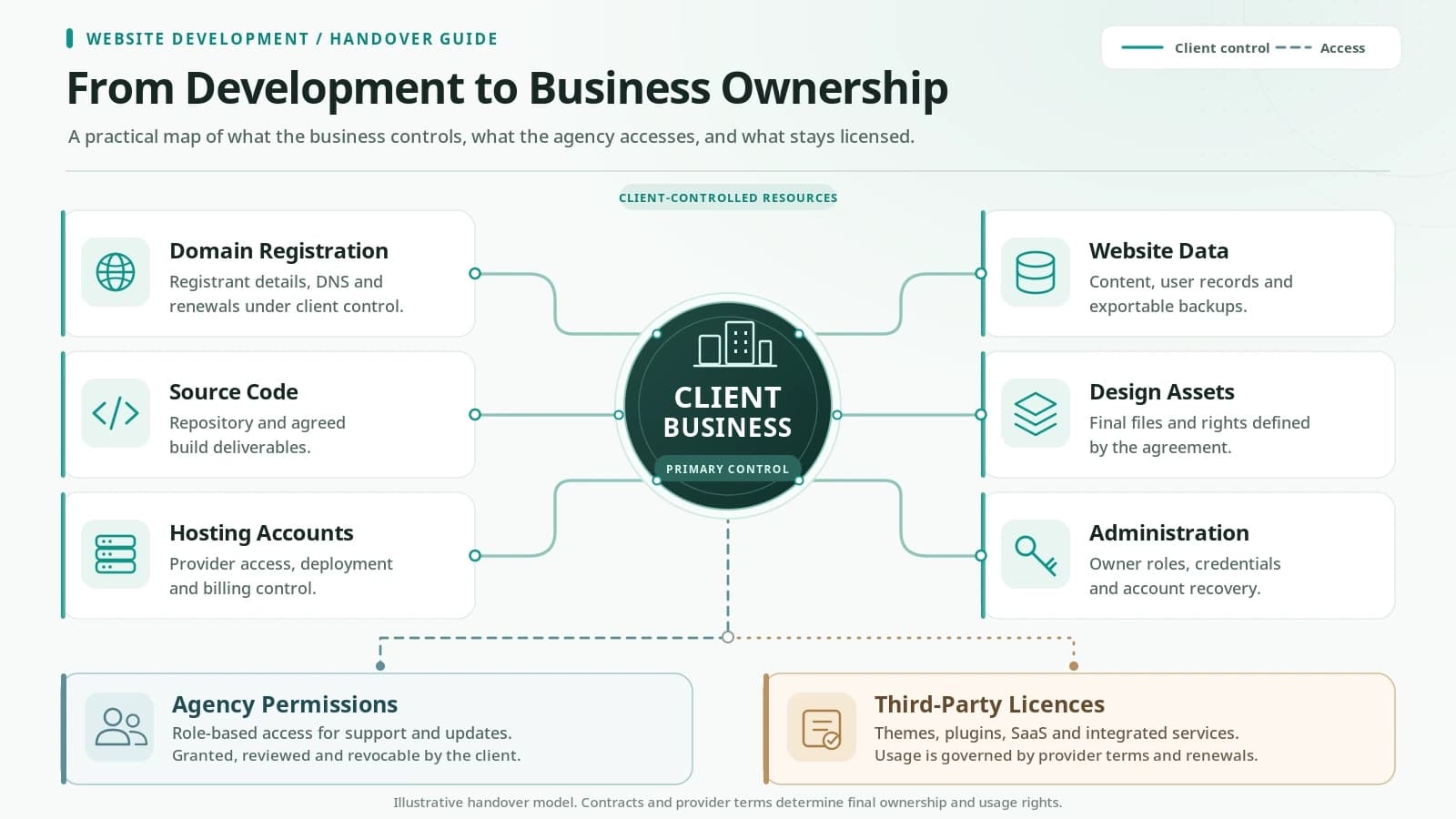
Caption: A complete handover clarifies what the business owns, controls and continues to licence.
What Should Be Included in a Professional Website Development Proposal?
A proposal should describe the actual engagement, rather than relying on promises such as "modern design", "fully responsive" or "complete website".
The following deliverables framework provides a practical starting point:
| Project stage | Evidence or deliverable to request |
|---|---|
| Discovery and scope | Requirements, exclusions, priorities and responsibilities |
| Planning | Sitemap, wireframes or relevant technical specifications |
| Design | Approved screens, responsive behaviour and revision scope |
| Development | Working pages, functionality and documented integrations |
| Testing | Acceptance criteria, test results and agreed defect resolution |
| Deployment | Production configuration, domain connection and launch checks |
| Handover | Agreed code and asset deliverables, account access and documentation |
| Support | Defect warranty, maintenance responsibilities and future-work arrangements |
Not every project requires an extensive specification or separate documents for every stage. A modest business website can use a concise written agreement. A complex application generally needs more detailed requirements and acceptance procedures. The distinction is proportionality.
A good proposal gives the client enough information to understand what is included, what isn't and how completion will be judged.
Stratify Studio describes its own project development process, including discovery, planning, design and implementation. Whatever agency you commission, the individual agreement should take precedence over a general description of its workflow.
What Influences Website Development Costs in Pakistan?
Website development quotations can differ substantially because suppliers may be pricing different scopes, even when the requested websites appear similar.
A design-only engagement, a customised CMS installation and a bespoke customer portal have different labour and maintenance requirements. Cost is influenced by the number and complexity of distinct page layouts, content preparation, integrations, user permissions, custom functionality, testing and deployment.
The website development cost guide examines these variables separately.
Businesses should also distinguish the original development fee from recurring expenses such as hosting, domain renewals, licensed software, payment-provider fees and maintenance. A custom application may require ongoing engineering attention. A managed ecommerce platform may shift more infrastructure work to the provider but introduce subscription and application fees.
Stratify Studio's website hosting guide provides further context on infrastructure and operational costs.
For projects commissioned in Pakistan, quotations should clarify payment milestones, applicable taxes, currency and third-party charges. International clients should also establish settlement arrangements, approval procedures and overlapping communication hours.
These matters aren't secondary details. They influence the full cost and manageability of the project.
What Makes a Website Professionally Complete?
A website can be visually finished without being operationally ready.
Professional completion means the agreed experience works, essential requirements have been tested, known limitations have been documented and the business understands what it owns and how the system will be supported.
This standard applies whether the project uses a carefully configured template, an established ecommerce platform or a custom-engineered application.
The appropriate level of sophistication depends on the business. The expectation of accountable delivery shouldn't.
Before approving a project, ask for an understandable scope, a justified technical approach, clear acceptance criteria and a defined handover. Those documents provide a more dependable basis for a development decision than an attractive presentation alone.
If you're planning a business website and need to establish its requirements or technical scope, you can discuss the project with Stratify Studio.
A well-planned project begins with understanding what needs to be built, and what the business will need after it goes live.
Verified External References
The following sources support the architectural, performance, and accessibility standards explained in this guide:
Rendering and interactive component architecture
Supported deployment options and their limitations
Update procedures, plugin compatibility and backup considerations
Eligibility for Shopify Payments and use of third-party providers
Loading, interaction and visual-stability measurements
Accessibility standards and testable criteria
Web application security requirements
Rendering and search discoverability for JavaScript websites
Technical search fundamentals and indexing limitations